WASHINGTON D.C. – In a resolute move to fortify domestic supply chains vital to its economic, energy, and national security, the U.S. Department of Energy (DOE) today announced a substantial investment of $500 million. This funding, channeled through the DOE's Office of Critical Minerals and Energy Innovation (CMEI), is earmarked for seven selected projects designed to significantly expand critical mineral and material processing, battery manufacturing, and recycling capabilities within the United States.
The announcement, made on August 20, 2026, aligns directly with President Trump’s Executive Order, Unleashing American Energy, a broad directive aimed at bolstering American energy dominance and reducing the nation’s reliance on foreign entities for essential resources. This strategic allocation represents the third round of funding from the DOE’s dedicated Battery Materials Processing and Battery Manufacturing and Recycling programs, which have been instrumental in supporting the development of a robust domestic battery value chain.
The Strategic Imperative: Securing Critical Mineral Supply Chains
Critical minerals and materials are the fundamental building blocks of modern technology, underpinning everything from advanced electronics and renewable energy infrastructure to defense systems and electric vehicles (EVs). Minerals such as lithium, cobalt, nickel, graphite, and various rare earth elements are indispensable for the high-performance batteries powering the global energy transition. For decades, the United States has faced a growing dependency on foreign sources, particularly from countries with complex geopolitical dynamics, for the processing and manufacturing stages of these crucial materials.
This reliance creates significant vulnerabilities. Geopolitical tensions, trade disputes, and supply disruptions in producing nations can directly impact U.S. industries, raise manufacturing costs, and potentially jeopardize national security interests. Recognizing this profound challenge, the U.S. government has prioritized the re-shoring and expansion of domestic capabilities across the critical mineral value chain.
U.S. Secretary of Energy Chris Wright underscored the gravity of the situation in his statement: "For too long, America has depended on foreign actors for critical materials essential to modern life that underpin our economy, energy security, and national security. President Trump is reversing that dependence by securing our critical supply chains, unleashing American industry, and bringing critical materials production and processing back to the United States." This sentiment is echoed by Assistant Secretary of Energy Audrey Robertson, who added, "DOE is taking decisive action to secure the critical supply chains necessary to power our nation. These projects underscore DOE’s commitment to driving innovation, reducing reliance on foreign sources, and promoting American energy dominance."
DOE's Targeted Investment: Building Domestic Capacity
The $500 million investment targets a crucial gap in the American critical mineral ecosystem: the midstream processing and manufacturing capabilities. While the U.S. possesses significant mineral endowments, the infrastructure for converting raw mined materials into battery-grade chemicals or components has largely diminished or never fully developed domestically. These new projects are designed to bridge that gap by supporting:
- Critical Mineral and Material Processing: Transforming raw ore into high-purity materials suitable for manufacturing.
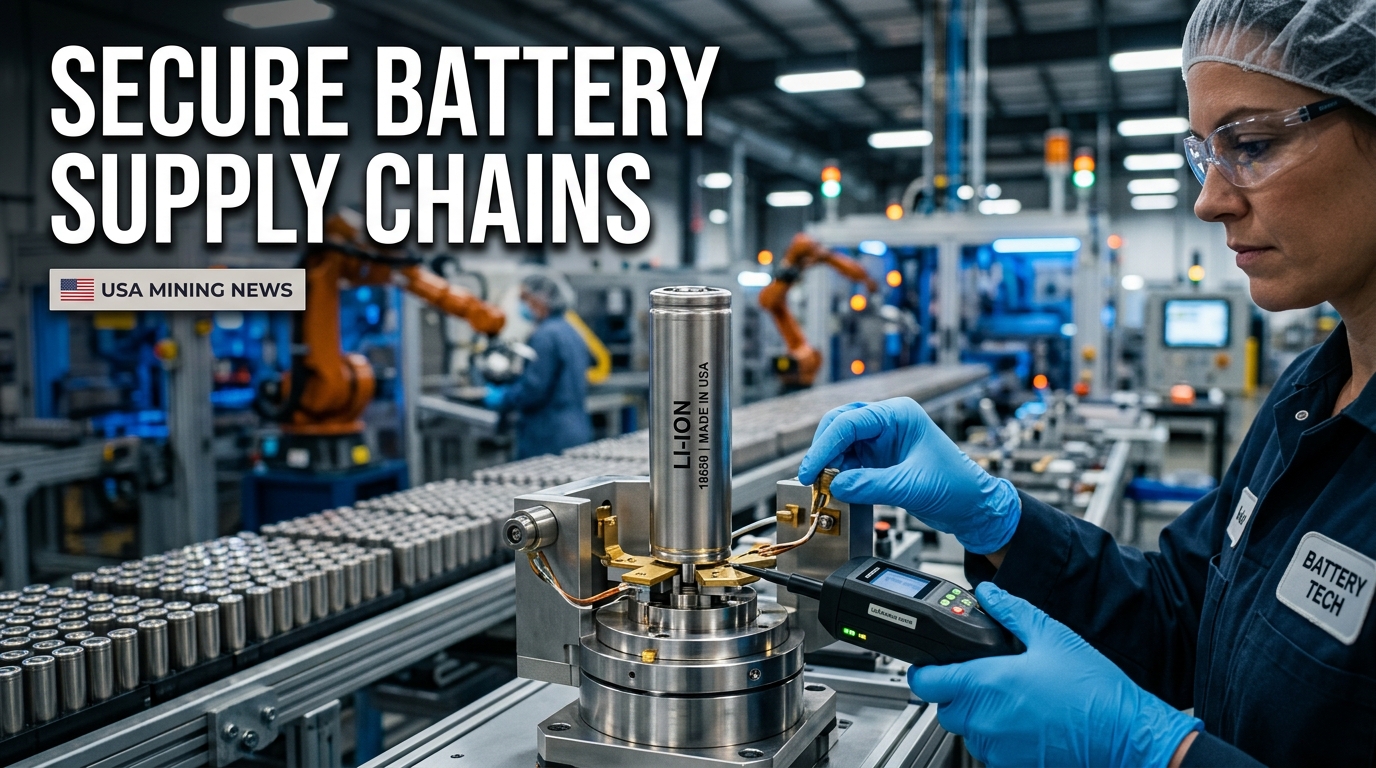
- Battery Manufacturing: Producing cells, modules, and full battery packs for various applications, particularly EVs and grid-scale energy storage.
- Recycling Capacity: Developing and scaling technologies to recover critical minerals from end-of-life batteries, creating a circular economy that reduces demand for primary extraction and minimizes environmental impact.
The funding programs – Battery Materials Processing and Battery Manufacturing and Recycling – are structured to support a range of project types, from initial demonstration projects proving new technologies, to the construction of commercial-scale facilities, and the retrofitting or retooling of existing industrial sites. While the specific details of the seven selected projects were not immediately disclosed in the announcement, their collective aim is clear: to establish a comprehensive and resilient domestic supply chain from raw material to finished product and back through recycling.
Broader Industry Impact for Mining Professionals and Investors
For the U.S. mining industry, this significant investment represents a powerful demand signal and a strategic shift. Historically, the lack of downstream processing and manufacturing facilities in the U.S. meant that even if critical minerals were mined domestically, they often had to be shipped overseas for further refinement. This created a disconnect and reduced the economic incentive for large-scale domestic extraction.
The DOE's focus on processing, manufacturing, and recycling fundamentally changes this dynamic. By building out these midstream and downstream capabilities, the government is effectively creating a robust domestic market for U.S.-sourced critical minerals. This has several profound implications:
- Increased Domestic Demand: New processing plants will require a steady, reliable supply of critical mineral concentrates, directly stimulating demand for domestic mining operations. This can de-risk new mining projects and encourage further exploration and development.
- Investment Opportunities: The creation of an integrated supply chain offers new investment avenues, not just in mining but also in beneficiation, refining, and specialized logistics that connect mines to processing facilities.
- Strategic Resource Development: A secure domestic supply chain strengthens the economic viability of developing previously marginalized U.S. critical mineral deposits, including those that might have been deemed uneconomical under a purely export-oriented model.
- Technological Advancement: Funding for demonstration projects can spur innovation in more sustainable mining and processing techniques, reducing environmental footprints and improving resource efficiency.
This initiative sends a clear message to mining companies, investors, and stakeholders: the U.S. government is committed to fostering a complete critical mineral ecosystem within its borders. This long-term commitment helps de-risk capital-intensive mining projects by providing greater certainty for future demand.
Bridging the Gap: From Mine to Manufacturing
The mining sector understands that the value chain extends far beyond the initial extraction. A critical mineral, when first extracted from the earth, is rarely in a form immediately usable by a battery manufacturer. It must undergo several stages of processing, including crushing, grinding, flotation, chemical leaching, and purification, to produce battery-grade precursors or refined metals. This midstream processing has been a significant bottleneck for the U.S.
The projects funded by the DOE are specifically designed to address this bottleneck, creating the infrastructure necessary to convert raw materials into value-added products domestically. This not only enhances economic security but also improves the transparency and traceability of the supply chain, allowing for greater oversight regarding labor and environmental standards.
The Crucial Role of Recycling in a Circular Economy
Beyond primary extraction and processing, the integration of recycling into the funding strategy highlights a comprehensive approach to critical mineral security. Recycling end-of-life batteries offers a dual benefit: it reduces the need for virgin material extraction, thereby lessening environmental impact, and it creates a supplementary, domestically controlled source of critical minerals. As the number of electric vehicles and stationary storage solutions grows exponentially, so too will the volume of batteries reaching the end of their usable life, making recycling a cornerstone of a sustainable and secure mineral supply.
A Series of Investments: A Long-Term Vision
This $500 million announcement marks the third round of funding from these DOE programs, indicating not an isolated event but a sustained, multi-year commitment to building out domestic capabilities. This consistent investment strategy provides long-term confidence for industry players, encouraging them to make significant capital investments in U.S. facilities and operations. The administration's unwavering focus, encapsulated by the Unleashing American Energy Executive Order, suggests that such funding initiatives will likely continue, creating a stable policy environment conducive to growth in the critical minerals sector.
Future Outlook and Challenges
While the investment is substantial and the strategic intent is clear, the path to full critical mineral supply chain independence is not without its challenges. The industry will need to navigate complex permitting processes, address environmental considerations, and cultivate a skilled workforce capable of operating advanced processing and manufacturing facilities. Workforce development, particularly in engineering, chemistry, and specialized trades, will be crucial to maximize the impact of these investments.
Nevertheless, the DOE's latest funding round represents a significant leap forward in America’s pursuit of energy dominance and national security. By strategically investing in the processing, manufacturing, and recycling segments of the critical mineral and battery supply chains, the United States is actively laying the groundwork for a more resilient, self-reliant, and sustainable future. For mining companies and investors, this commitment signals a burgeoning opportunity to participate in and benefit from the revitalization of America’s industrial base.