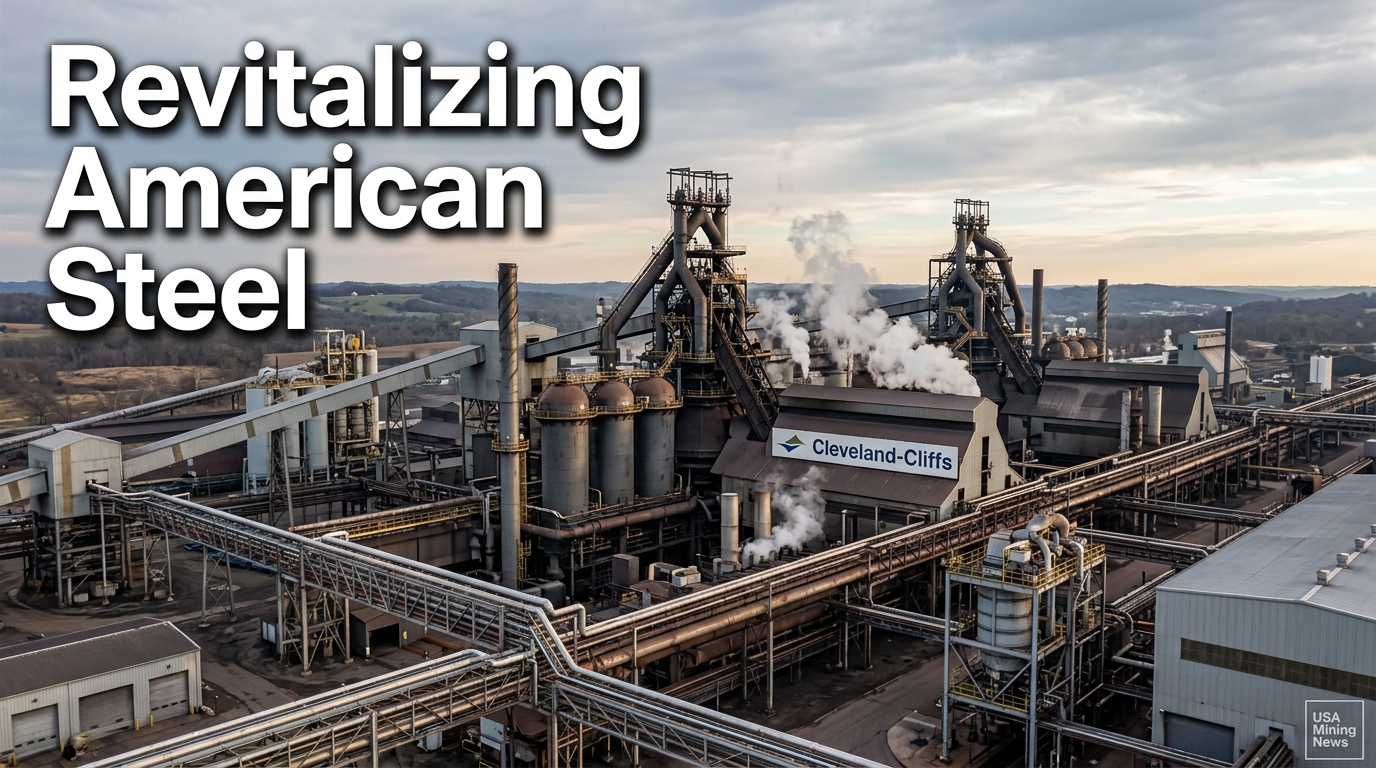
Washington D.C. – The American steel industry, a foundational pillar of the nation’s manufacturing base, is poised for a significant revitalization through a substantial federal investment. On August 21, 2026, the U.S. Department of Energy (DOE) announced a $500 million award to Cleveland-Cliffs, Inc., supporting a comprehensive $1 billion modernization initiative at the company’s Middletown Works facility in Middletown, Ohio. This landmark commitment is set to protect 2,300 American jobs and fortify domestic steel production capabilities, underscoring a strategic emphasis on industrial strength and national security.
The announcement, made during a visit to Middletown Works by Vice President JD Vance and U.S. Energy Secretary Chris Wright, highlights the Trump Administration’s declared commitment to bolstering American steelworkers and driving a resurgence in domestic manufacturing. This investment is not merely an upgrade; it represents a calculated maneuver to modernize critical infrastructure, ensuring the long-term competitiveness and resilience of a sector vital to numerous downstream industries, from automotive to defense.
A $1 Billion Investment in Core Industrial Strength
The total investment package, a formidable $1 billion, comprises the $500 million federal award from the DOE, complemented by an equal contribution from Cleveland-Cliffs itself. This substantial capital injection is earmarked for one of the nation’s most important steelmaking sites: Middletown Works. As the largest flat-rolled steel producer in the United States, Cleveland-Cliffs operates facilities like Middletown Works that are crucial nodes in the national manufacturing network, supplying essential steel products to a diverse array of American manufacturers. These include the automotive sector, critical heating and cooling (HVAC) manufacturers, appliance producers, and the extensive steel-distribution industry.
The strategic importance of this facility, located in the heart of Ohio, extends beyond direct production figures. It represents a domestic bulwark against reliance on foreign steel, a concern frequently voiced by policymakers regarding economic stability and national security. By strengthening Middletown Works, the investment aims to ensure a reliable domestic supply of high-purity steel, a critical component for a vast array of goods that Americans utilize daily. Assistant Secretary of Energy Audrey Robertson emphasized this point, stating, “DOE is proud to partner with Cleveland-Cliffs to reduce America’s dependence on foreign products and position key domestic industries—including automotive, HVAC, appliance, and steel-distribution industries—for long-term competitiveness.”
Strategic Shift: Modernization Over "Green Premium"
A notable aspect of this project is its evolution from an initial concept. Cleveland-Cliffs had originally explored a different project scope, one presumably focused on more transformative "green" steelmaking technologies. However, the company determined that the business case for this original scope "no longer made sense given customers’ unwillingness to pay a ‘green premium’ for steel." This candid assessment provides valuable insight into the prevailing economic realities faced by heavy industries as they navigate decarbonization pressures. While aspirational "green" technologies, often relying on hydrogen-based direct reduced iron (DRI) processes, promise significant emissions reductions, their higher production costs often present a formidable barrier in competitive markets where customers are not yet willing to absorb the added expense.
In response to this market reality, Cleveland-Cliffs, in collaboration with the DOE, pivoted to a pragmatic alternative. The revised plan focuses on optimizing and improving the efficiency of the existing coal-fired blast furnace infrastructure at Middletown Works. This approach acknowledges the immediate economic constraints while still pursuing substantial gains in operational efficiency and environmental performance within the framework of established technology. The specific modernization efforts include:
- Rebuilding and Upgrading the Main Coal-Fired Ironmaking Furnace: This core component of the steelmaking process will undergo a comprehensive overhaul, extending its operational life, enhancing its performance, and improving energy efficiency. Such an upgrade typically involves improvements to refractories, cooling systems, charging mechanisms, and process control systems.
- Deploying AI to Optimize Furnace Operations: The integration of artificial intelligence (AI) is a significant technological leap. AI systems can analyze vast datasets from furnace operations in real-time, predicting optimal operating parameters, minimizing energy consumption, and reducing waste. This intelligent automation contributes directly to improved energy efficiency and overall productivity.
- Building an On-Site Facility to Convert Steel Mill Process Gases into Electricity: This is a key circular economy initiative. Blast furnace gas (BFG), a co-product of ironmaking, is a low-calorific value fuel that can be captured and utilized. By converting BFG into electricity on-site, Middletown Works can reduce its reliance on external power grids, lower its operational costs, and decrease its overall carbon footprint associated with energy consumption. This practice represents a significant step towards resource efficiency within traditional steelmaking.
- Follow-on Investments for Industrial Byproduct Utilization: Further demonstrating a commitment to resource circularity, subsequent investments are planned to transform other industrial byproducts from the steelmaking process into materials suitable for concrete used in regional infrastructure projects. This not only minimizes waste but also contributes to the sustainability of the construction sector.
Protecting Jobs and Fortifying Domestic Supply Chains
Beyond the technological advancements, a central tenet of this investment is the protection of American jobs. The project is explicitly designed to safeguard 2,300 high-paying manufacturing positions at Middletown Works. In an era where manufacturing jobs have faced significant pressures, this commitment to job retention and creation in the industrial heartland is a powerful statement. Secretary Wright underscored this, stating, “This investment puts American workers and American manufacturing first. It will modernize one of our nation’s critical steelmaking facilities, protect thousands of jobs, and strengthen our domestic steel production—keeping Ohio at the heart of American manufacturing and strengthening our national security.”
The strategic importance of this investment extends far beyond the confines of the Middletown facility. By ensuring the continued vitality of Cleveland-Cliffs’ operations, the DOE is actively reinforcing critical domestic supply chains. The industries served by Middletown Works—automotive, HVAC, appliances, and steel distribution—are foundational to the American economy. A robust, reliable domestic source of steel reduces vulnerability to global supply chain disruptions, geopolitical instability, and trade imbalances, thereby strengthening America's overall economic and national security posture.
Broader Implications for the Mining and Steel Sectors
For the broader mining industry, this announcement carries several significant implications. The decision to invest in upgrading existing coal-fired blast furnaces, rather than immediately transitioning to nascent "green" technologies, signals a sustained demand for traditional steelmaking raw materials. This includes both high-quality iron ore, which Cleveland-Cliffs also produces, and critically, metallurgical coking coal. While there is a global push towards decarbonization, this project highlights the continuing economic viability and technological resilience of blast furnace steelmaking, at least in the medium term, when supported by efficiency improvements and byproduct utilization. This pragmatic approach suggests that the transition away from coal-intensive processes in heavy industry will likely be a gradual, multi-faceted journey, heavily influenced by market demand and customer willingness to absorb higher costs for lower-carbon products.
Furthermore, the government’s direct financial intervention demonstrates a strategic recognition of the essential role of domestic foundational industries. The $500 million award from the DOE is not just an investment in a steel plant; it is an investment in industrial policy, aimed at preserving core capabilities and technological know-how within the United States. This model of public-private partnership, where government funds de-risk or accelerate critical industrial modernizations, could serve as a precedent for other sectors, including critical mineral processing and other energy-intensive industries linked to the mining value chain. It underscores a shift towards viewing industrial capacity as a strategic asset requiring state support.
The Path Forward: Securing America's Industrial Future
With construction on the Middletown Works project expected to commence in the coming weeks following the August 21, 2026 announcement, the transformation will begin swiftly. This initiative is more than just a capital expenditure; it’s a tangible commitment to the future of American manufacturing. By combining targeted federal funding with private sector expertise, the project aims to secure Cleveland-Cliffs’ competitive position, ensure the availability of essential steel for American industries, and provide thousands of workers with stable, high-paying jobs for years to come.
The modernization of Middletown Works, while leveraging traditional technologies, also integrates advanced solutions like AI and waste-to-energy conversion, demonstrating that innovation can occur within existing frameworks. This approach offers a powerful lesson: immediate, wholesale technological shifts are not always economically feasible or universally adopted. Instead, incremental yet significant improvements to existing industrial processes, coupled with strategic government backing, can play a crucial role in maintaining industrial competitiveness, protecting jobs, and contributing to a more resilient and secure domestic economy.