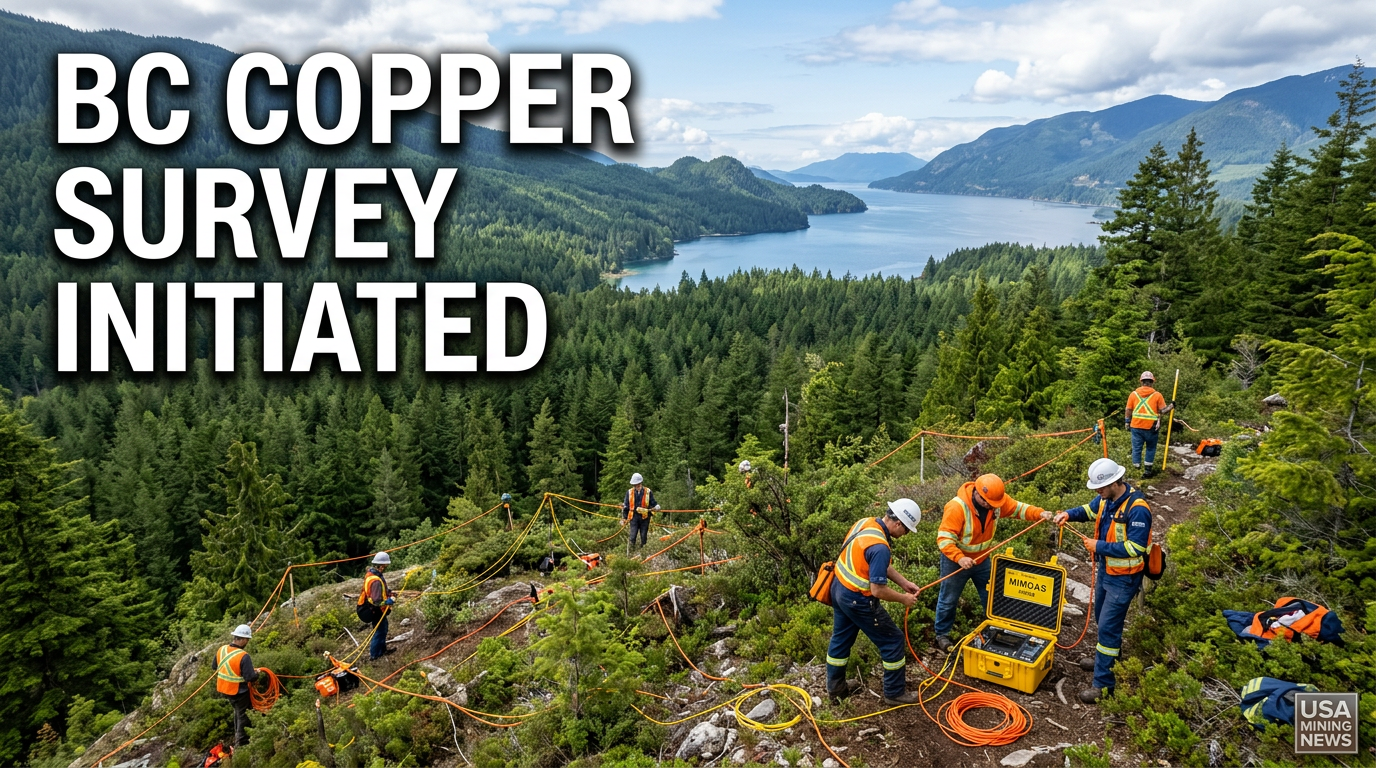
Questcorp Mining has initiated a critical induced polarisation (IP) survey at its 1,168-hectare North Island Copper Project in British Columbia, Canada. This 10-15 line-kilometre survey, conducted by Peter E. Walcott & Associates, aims to verify and enhance historical geophysical targets within the Marisa Zone porphyry copper system, building on prior exploration that revealed copper mineralization in 1992. The programme is a key precursor to refining geological models and developing precise drill targets, positioning Questcorp to advance a compelling porphyry copper prospect supported by recent institutional financing from Sorbie Bornholm.
Questcorp Launches Targeted Geophysical Survey at North Island Copper Project
In a strategic move to advance its promising North Island Copper Project, Questcorp Mining has commenced an induced polarisation (IP) survey at its 1,168-hectare asset located near Port Hardy on Vancouver Island, British Columbia, Canada. This geophysical campaign represents a pivotal step in the company's diligent exploration efforts aimed at unlocking the potential of a demonstrated porphyry copper system. The survey, spanning an estimated 10 to 15 line kilometres, is being expertly executed by Peter E. Walcott & Associates, a Coquitlam, BC-based firm renowned for its specialized geophysical services.
The primary objective of this current IP survey is multifaceted: to meticulously verify and enhance historical geophysical targets situated within the project's Marisa Zone. Known for its porphyry copper system characteristics, the Marisa Zone holds the promise of significant mineralization. By generating high-resolution data, Questcorp intends to lay robust groundwork for the subsequent, critical phase of exploration: the precise delineation of follow-up drilling targets. This disciplined approach underscores the company's commitment to de-risking future drilling campaigns and optimizing capital deployment in a typically capital-intensive sector.
Refining Historical Data for Future Drilling: The Strategic Imperative of the IP Survey
Induced polarisation (IP) surveys are a cornerstone technique in modern mineral exploration, particularly effective in identifying disseminated sulfide mineralization often associated with large-scale porphyry deposits. The methodology involves injecting controlled electrical currents into the ground and measuring the resulting chargeability (the ability of rocks to store an electrical charge) and resistivity (the resistance of rocks to electrical current flow). Anomalies in these measurements can indicate the presence of conductive minerals like sulfides, as well as distinct rock types or structural features that host mineralization.
For the North Island Copper Project, the ongoing IP survey is designed with precision. The new survey lines are strategically positioned between the existing 1991 and 1992 IP lines, meticulously adhering to the historical survey azimuth. This deliberate placement is critical for significantly increasing the data resolution across the designated target area within the Marisa Zone. The overarching goal is not merely to replicate past efforts but to build incrementally and methodically upon them.
Upon completion of the field work, both the newly acquired dataset and the comprehensive historical data will be integrated and processed. This combined analysis will yield updated chargeability and resistivity models, complemented by detailed pseudosection interpretations. These advanced subsurface models are instrumental in enhancing the precision of targeting before any costly drilling programme is initiated. By minimizing uncertainty, Questcorp aims to maximize the probability of drilling success, a vital consideration for any exploration venture. This methodical approach is widely regarded as industry best practice, allowing companies to refine their geological understanding and prioritize targets most likely to host significant mineralization, thereby conserving capital and accelerating project development.
Decades of Promise: The Marisa Zone's Historical Footprint
The decision to embark on this focused IP survey is strongly informed by compelling historical data from the North Island Copper Project, particularly within the Marisa Zone. Previous exploration efforts, dating back more than three decades, provided early indications of the area's porphyry copper potential. In 1992, an exploration programme specifically tested a significant IP chargeability anomaly identified in 1991. From a total of five diamond drill-holes completed during that period, two yielded encouraging results, demonstrating clear copper mineralisation.
Specifically, drill hole DDH92-01 intersected 0.078% copper over a substantial 56.39 metres. Equally notable, DDH92-03 reported 0.041% copper over 70.71 metres. Intrigued by the findings, geologists observed that DDH92-03 showed higher copper grades at depth, suggesting a potentially strengthening mineralized system at greater depths. Both mineralized intercepts were identified within altered quartz diorite, a geological setting commonly associated with porphyry copper deposits globally.
While these historical grades might appear modest in isolation when compared to ultra-high-grade vein deposits, it is crucial to interpret them within the context of porphyry systems. Porphyry copper deposits are characteristically large-tonnage, low-to-medium-grade systems where economic viability is driven by the sheer scale of the mineralised body rather than exceptionally high grades. The presence of consistent copper mineralization over significant widths, combined with indicators of increasing grades at depth, provides strong encouragement for the potential existence of a substantial, economic resource. These historical results are compelling indicators that warrant further, more detailed investigation, making the current IP survey a logical and necessary progression for Questcorp.
Questcorp's Strategic Trajectory and Capital Deployment
Questcorp Mining's President and CEO, Saf Dhillon, articulated the company's strategic vision for the North Island Project, stating, “The North Island Copper Project represents a compelling porphyry copper target with demonstrated historical mineralisation. This IP programme is a disciplined step toward refining our geological model and advancing toward drill-ready targets.” His comments underscore a clear, methodical progression from historical data verification to the generation of actionable exploration targets. Dhillon's emphasis on a "disciplined step" highlights a prudent approach to exploration, focusing on systematic data acquisition and interpretation to minimize risk before committing to more capital-intensive drilling programmes.
The company's capacity to execute its planned exploration programmes is further strengthened by recent financial developments. In November 2025, Questcorp successfully secured an initial investment from Sorbie Bornholm, a reputable institutional investor based in the United Kingdom. Such backing from an institutional player signals external confidence in Questcorp's assets and strategic direction, providing crucial financial runway for its exploration endeavors. Dhillon further affirmed, “With our recent financings completed, the company is well positioned to execute its planned exploration programmes while maintaining a prudent approach to capital deployment.” This assurance is critical for shareholders and potential investors, demonstrating that Questcorp is adequately funded to achieve its immediate exploration objectives while managing financial resources responsibly. In an industry where exploration success is inherently uncertain and capital-intensive, a robust financial position and a clear capital deployment strategy are paramount for sustainable growth and value creation.
British Columbia's Porphyry Landscape and the North Island Project
The North Island Copper Project is situated in an historically prolific mining jurisdiction: British Columbia, Canada. BC is globally renowned for its significant mineral wealth, particularly its endowment of large-scale porphyry copper-gold-molybdenum deposits. This geological setting hosts numerous world-class operations and advanced projects, including Teck Resources' Highland Valley Copper, Imperial Metals' Mount Polley, and Copper Mountain Mining's Copper Mountain. The presence of such significant mines underscores BC's favorable geology for porphyry systems and its well-established mining infrastructure and regulatory framework.
Vancouver Island, where the 1,168-hectare North Island project is located, has its own history of mineral exploration and development. While perhaps not as densely populated with large operating mines as BC’s interior, the island’s geology shares affinities with the province’s highly prospective arcs, offering potential for similar deposit types. The project's proximity to Port Hardy, a key service centre on the northern tip of Vancouver Island, offers distinct advantages. Access to essential infrastructure, including roads, power, and a skilled workforce, coupled with a deep-water port, significantly reduces the logistical complexities and potential costs often associated with remote exploration projects. This established infrastructure provides a competitive edge, facilitating the movement of equipment, personnel, and eventually, if successful, concentrate to market.
The Critical Role of Copper in a Decarbonizing World
Questcorp's focus on a porphyry copper target aligns with major global economic and environmental trends. Copper, often referred to as "Dr. Copper" for its perceived ability to predict economic health, is now lauded as "the metal of electrification." Global demand for copper is projected to experience substantial growth in the coming decades, driven by several powerful megatrends: the accelerating transition to renewable energy sources, the burgeoning electric vehicle (EV) market, the expansion of charging infrastructure, and continued urbanization and industrialization in emerging economies. Every wind turbine, solar panel, EV, and smart grid system relies heavily on copper for its superior electrical conductivity and durability.
Despite this surging demand, the supply side faces significant challenges. Declining ore grades at existing mines, a protracted and complex permitting process for new projects, and a general scarcity of large-scale, high-quality new discoveries are contributing to a looming supply deficit. This imbalance between escalating demand and constrained supply underscores the critical importance of advancing projects like North Island. New discoveries and the development of previously identified prospects are essential to meet the world’s growing hunger for this vital metal. Porphyry deposits, by virtue of their immense scale and long potential mine lives, are particularly attractive as they have the capacity to deliver the large volumes of copper required to support global decarbonization efforts. Thus, successful exploration at North Island could contribute not only to Questcorp's growth but also to the broader global supply chain essential for a sustainable future.
Paving the Way for Future Resource Delineation
The initiation of the IP survey at the North Island Copper Project marks a significant and calculated step forward for Questcorp Mining. Upon completion of the geophysical fieldwork and subsequent data processing, the immediate next phase will involve the detailed interpretation and integration of the new, high-resolution IP data with all available historical information, including geological mapping, geochemical sampling, and the legacy drill results from 1992. This comprehensive dataset will be critical in developing a refined geological model for the Marisa Zone.
The ultimate goal of this integrated geological and geophysical campaign is the generation of precise, high-priority drill targets. Once these targets are confidently identified, Questcorp will be poised to move towards an initial diamond drilling program, which would constitute the next major milestone for the project. A successful drilling program could potentially define a maiden mineral resource, validating years of exploration and opening avenues for preliminary economic assessment studies.
While exploration inherently carries risks, Questcorp’s disciplined, data-driven strategy at North Island positions it well to systematically explore a compelling porphyry copper target within a favorable jurisdiction. The outcomes of this current IP survey will be eagerly anticipated by industry observers and investors alike, as they will provide crucial insights into the potential scale and viability of the project and its contribution to the future copper supply landscape in British Columbia and globally.