In a significant development for the global gold mining sector, China’s Zijin Mining, one of the world’s foremost gold producers, is moving forward with an ambitious expansion plan in Kazakhstan. Following its strategic acquisition of Kazakh gold mining company RG Gold in 2025 for an impressive $1.2 billion, Zijin Mining has announced its intention to commence construction of a state-of-the-art $500 million processing plant in Kazakhstan during the current year, 2026. This substantial investment underscores the region's growing importance in the global mining landscape and Zijin's commitment to expanding its operational footprint.
Crucially, this operational growth is being paired with an innovative, comprehensive environmental protection program spearheaded by RG Gold, which has garnered international recognition. At the heart of this initiative is the deployment of 'phytocapture' technology, a pioneering method developed by the Sustainable Kazakhstan Research Institute (SKRI), aimed at mitigating airborne dust particles generated by open-pit mining activities near RG Gold's Raygorodok deposit.
Zijin Mining's Strategic Expansion in Eurasia
Zijin Mining’s $1.2 billion acquisition of RG Gold in 2025 represented a calculated move to solidify its presence in Central Asia, a region increasingly recognized for its rich mineral endowments and strategic geopolitical importance. Kazakhstan, with its vast reserves of gold, copper, and other critical minerals, offers a compelling environment for major mining players seeking growth opportunities. The planned $500 million investment in a new processing plant, slated for construction in 2026, will significantly enhance RG Gold's operational capacity at the Raygorodok deposit, boosting production and optimizing efficiency. For a global powerhouse like Zijin, which operates across multiple continents, this expansion in Kazakhstan aligns with a broader strategy of diversifying assets and securing long-term resource supplies, particularly in the gold sector.
The integration of RG Gold into Zijin's portfolio is not merely about increasing output; it also brings a strong commitment to sustainable practices. Industry observers note that major international acquisitions increasingly consider the environmental, social, and governance (ESG) performance of target companies. RG Gold's proactive stance on environmental protection, particularly its engagement with cutting-edge technologies like 'phytocapture,' likely played a role in its attractiveness to a responsible global investor like Zijin Mining, ensuring continuity of best practices post-acquisition.
The Raygorodok Operation and Environmental Imperatives
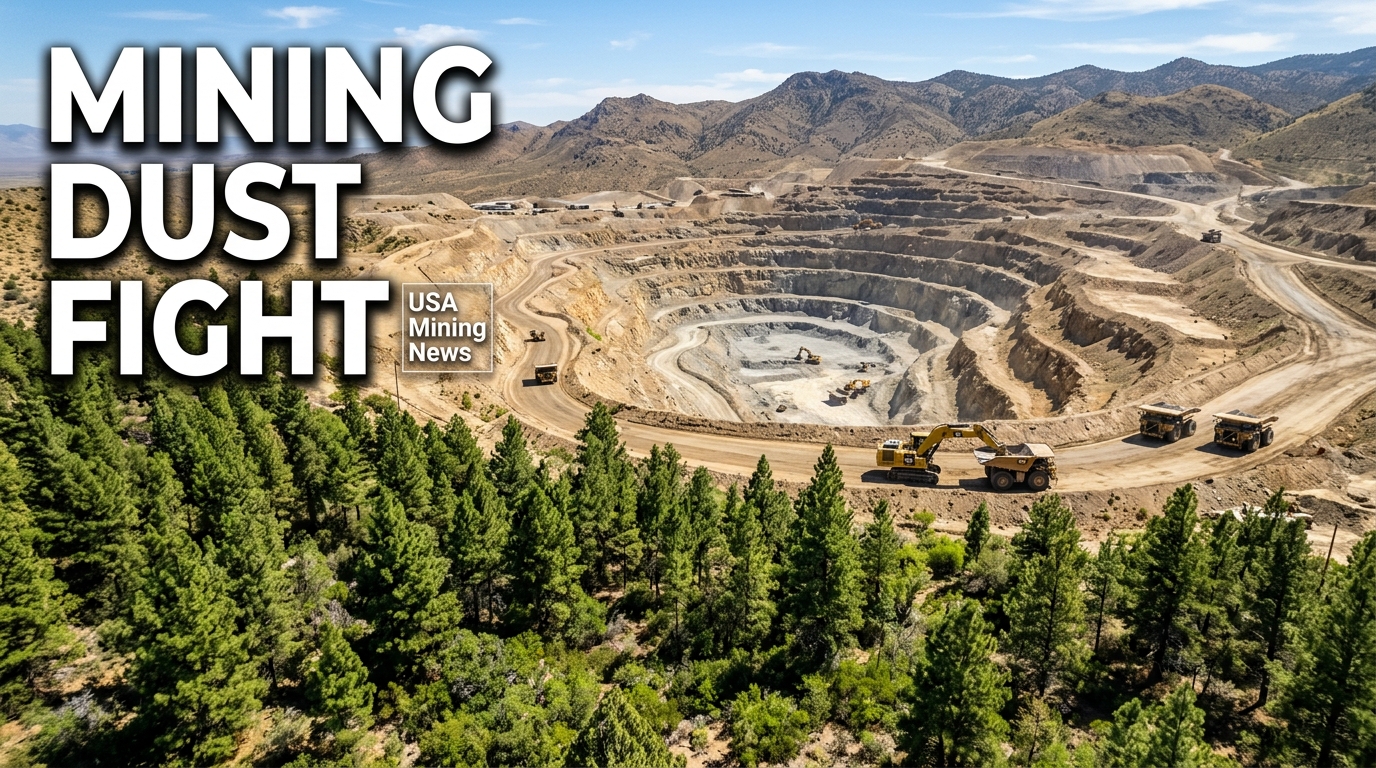
The Raygorodok gold deposit, located in Kazakhstan, is characteristic of many modern mining operations utilizing open-pit methods. While highly efficient for accessing large, near-surface ore bodies, open-pit mining inherently presents significant environmental challenges, most notably the generation of airborne dust. This particulate matter, if left unmanaged, can impact local air quality, pose health risks to workers and nearby communities, and contribute to soil degradation and water contamination. Consequently, effective dust suppression is a critical component of responsible mining, often involving substantial investment in water spraying, chemical stabilizers, or physical barriers.
Recognizing these challenges, RG Gold has been implementing a robust environmental protection program. As early as November 2025, the company had already planted more than 100,000 Scots pine trees in the vicinity of its Raygorodok deposit. This extensive afforestation effort was specifically designed to act as a natural barrier, capturing and filtering dust particles before they disperse over wider areas. This proactive stance by RG Gold, even before its acquisition by Zijin Mining, positioned it as a leader in environmental stewardship within the Kazakh mining sector, a commitment that has been emphatically continued and supported by the new parent company.
Unpacking 'Phytocapture': A Fusion of Ecology and High-Tech
The innovative 'phytocapture' technology lies at the heart of RG Gold's environmental strategy. Developed by the Sustainable Kazakhstan Research Institute (SKRI), an influential environmental think tank at Narxoz University in Almaty, this method transcends traditional landscaping by integrating advanced scientific principles with ecological solutions. Narxoz University, significantly bolstered by Kazakh businessman and philanthropist Bulat Utemuratov through his investment group Verny Capital, has emerged as a regional leader in sustainability research, earning recognition as Kazakhstan's top private university in the Times Higher Education Impact Rankings in 2022. This academic excellence provides a strong foundation for SKRI's groundbreaking work.
The phytocapture initiative is based on the meticulous method of capturing fine airborne dust particles through strategically planted vegetation. What differentiates this approach is the rigorous scientific methodology employed. SKRI's technology leverages advanced supercomputer modeling, fed by extensive big data, including localized regional wind-rose patterns. This sophisticated analysis allows researchers to identify the most suitable tree species – in this case, Scots pine seedlings – and determine optimal planting distances and arrangements to maximize the efficiency of dust capture. This means the vegetative barriers are not merely aesthetic additions but carefully engineered systems designed for peak performance.
The implementation at RG Gold began with vegetative barriers planted in 2024, an effort that intensified with the planting of over 100,000 Scots pine trees by November 2025. For the current phase of the environmental program, more than 20 hectares have been dedicated to establishing a multilayered barrier system using these seedlings. This is further complemented by cultivating continuous grass cover, which serves to stabilize the soil, prevent erosion, and enhance the retention of airborne dust particles at ground level, creating a comprehensive natural filtration system. This intelligent design ensures that the greenery functions as a robust "frontline environmental protection system" rather than just a simple greenbelt.
Quantifiable Impact and Industry Recognition
The efficacy of the phytocapture approach is not just theoretical; it is yielding measurable results. According to Arman Markashov, General Counsel of RG Gold, the scientifically designed, multilayered barrier system utilizing native plant species has achieved a reduction in particulate matter concentrations by "more than 40%." This figure is significant, indicating a substantial improvement in local air quality and a powerful demonstration of the technology's effectiveness. Such considerable reductions in airborne dust are often challenging to achieve with conventional methods alone, highlighting the innovation inherent in phytocapture.
Furthermore, the long-term strategic placement of these vegetative barriers underscores their future importance. A protective forest belt has been established approximately 1.7 kilometers downwind of current operations. Brendan Duprey, Director of SKRI, noted the foresight embedded in this planning: "Once pollution sources move closer to the forest boundary, this plantation will be capable of capturing roughly one-third of dust emissions, transforming long-term land-restoration efforts into a powerful frontline environmental protection system for nearby communities." This perspective emphasizes the dual benefit of land rehabilitation and active environmental protection. The foresight in planning for future mine expansion, ensuring the protective belt remains effective even as the mine footprint changes, is a testament to the comprehensive nature of the project.
The phytocapture approach developed by SKRI has also received international acclaim, notably being recognized as a best practice under the United Nations Economic Commission for Europe (UNECE) Convention on the Transboundary Effects of Industrial Accidents. This recognition validates the project’s scientific rigor and its adherence to high environmental standards, positioning it as a model for sustainable development not just in Kazakhstan, but potentially for the wider global mining industry. The collaborative implementation by RG Gold and SKRI stands as a shining example of a carefully engineered environmental project that is deeply aligned with modern ESG standards and broader sustainable development goals.
The Broader Significance for the Mining Sector
The successful deployment of 'phytocapture' technology at RG Gold's Raygorodok deposit holds profound implications for the global mining sector. As regulatory pressures intensify and societal expectations for environmental stewardship grow, mining companies worldwide are seeking more sustainable and effective methods for managing operational impacts. Traditional dust suppression techniques, while necessary, often involve significant ongoing costs, high water consumption – a critical concern in arid regions – and may have limited long-term efficacy. Phytocapture offers a compelling alternative or complement, leveraging natural processes in a scientifically optimized manner.
This initiative underscores several key trends relevant to mining professionals and investors:
- Sustainable Solutions: It demonstrates the viability of nature-based solutions when integrated with advanced scientific and computational methods.
- Reduced Operational Costs: While initial planting requires investment, the long-term maintenance costs of a living barrier may be lower than continuous application of water or chemical suppressants, particularly considering resource scarcity.
- Community Relations: Proactive environmental measures like phytocapture significantly enhance a mine’s social license to operate, fostering better relationships with local communities by visibly mitigating environmental impacts.
- ESG Performance: This innovation directly contributes to a company’s Environmental, Social, and Governance (ESG) profile, which is increasingly vital for attracting capital and satisfying investor demands for responsible operations.
- Academic-Industry Collaboration: The partnership between RG Gold and SKRI highlights the immense value of collaboration between industry and research institutions in driving innovation for sustainability.
Kazakhstan, through initiatives like these, is positioning itself not just as a source of raw materials but as a hub for sustainable mining innovation in Central Asia, an increasingly important region on the global stage.
Future Outlook and Sustained Commitment
The 'phytocapture' project at the Raygorodok gold mine is a testament to a forward-thinking approach that integrates environmental protection into the core of mining operations. The long-term vision articulated by SKRI’s Director, Brendan Duprey, about the plantation evolving into a powerful environmental protection system as mining activities progress, encapsulates a deep understanding of mining lifecycle and dynamic environmental management.
With Zijin Mining Group at the helm, the continuation and probable expansion of this practice signify a robust corporate commitment to environmental responsibility. For a company of Zijin’s stature, embracing and further developing such innovative environmental technologies sends a powerful message to the industry globally. It suggests that sustainable practices are not merely regulatory compliance measures but integral components of modern, responsible, and economically viable mining operations. The success at Raygorodok could well serve as a blueprint for other open-pit mines facing similar dust management challenges around the world, making this Kazakh innovation a potential global standard for ecological mining.